

Maritime engineering projects, from a newbuild or conversion to a design office deliverable or an offshore campaign, carry risks to scope, schedule, cost, safety, quality and performance. Teams that recognise threats early put resources where they are needed and are far more likely to deliver successfully. This intermediate-level professional continuing-education course is about identifying, quantifying and managing risk in maritime engineering projects. Using maritime cases, learners practise a set of methods: heuristic screening, Product Breakdown Structures, FMEA (Failure Mode and Effect Analysis), Potential Problem Analysis, Root Cause Analysis and opportunity analysis. It explains how probability, consequence and buffer shape project exposure, how questionnaires surface weak boundary conditions, how a PBS and the three-colour method screen work packages, how risks are written, scored and quantified, how incidents are investigated to find root causes and missing barriers, and how risk-focused and opportunity-focused thinking combine with practical mitigation and a risk log.
Course at a glance: Duration 20 hours · Self-paced online · Level: Intermediate · 9 sections, 43 lessons, a 170-page downloadable course book
What you will learn
- Define project risk and explain how probability, consequence and buffer shape project exposure.
- Apply heuristic questionnaires to surface weak boundary conditions early in a project.
- Build a Product Breakdown Structure and use the three-colour method to screen work packages for risk.
- Analyse project vulnerabilities using Potential Problem Analysis and Failure Mode and Effect Analysis.
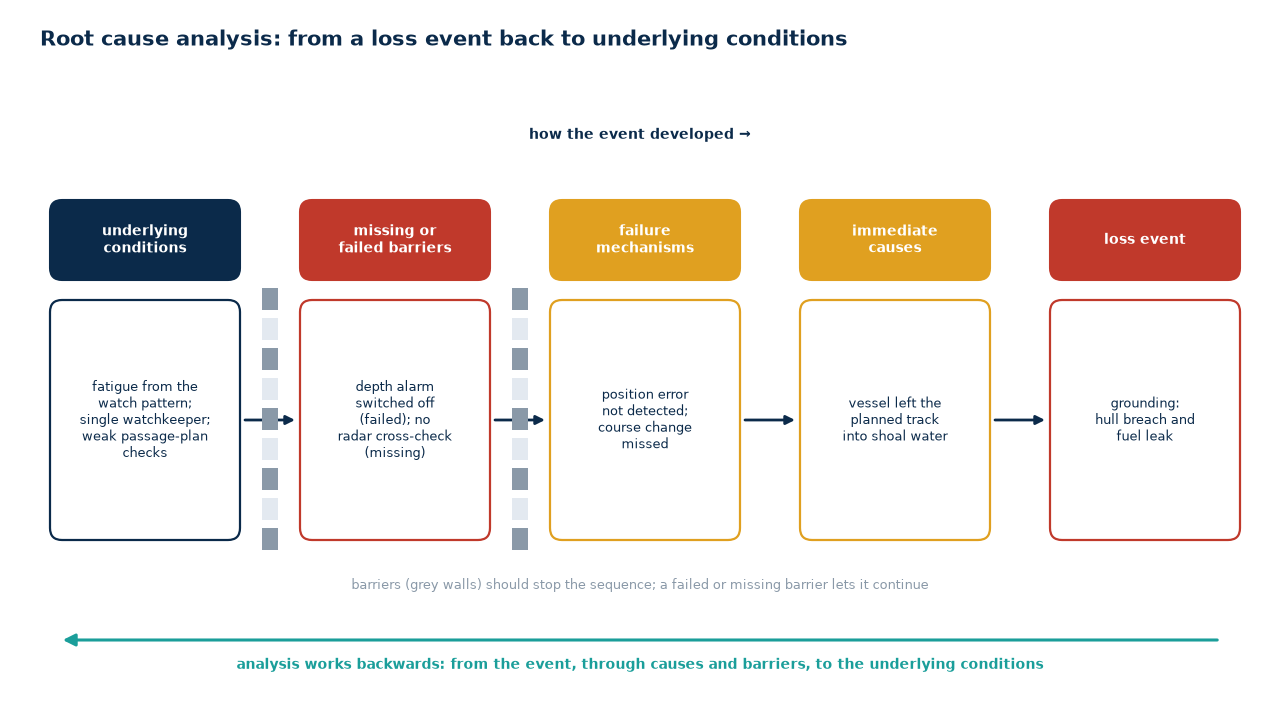
- Investigate incidents using Root Cause Analysis to identify root causes, failure mechanisms and missing barriers.
- Contrast risk-focused and opportunity-focused project thinking.
- Select practical risk-management measures and maintain a risk log for maritime projects.

Inside the course: a high-level summary, section by section.
Risk, consequence and buffer
The course begins by defining project risk as the combined effect of probability, how likely an undesired event is, and consequence, how severe its impact would be if not corrected in time. Buffer, the margin in time, cost or capacity available to absorb an event, shapes how exposed a project really is. The difference between risk analysis and risk management is explained, along with the interplay of time, cost and quality. The causes of project risk and the mindset needed to manage it are discussed, emphasising that early recognition of threats improves the chances of success and helps resources go where they are needed.
Heuristic screening
The heuristic approach gives a fast, structured way to screen risk before investing in deeper technical analysis. A five-step questionnaire-based method reveals weak boundary conditions, meaning the prerequisites a project needs in order to proceed under control. Each missing or shaky prerequisite can generally be rewritten as a risk. Questionnaire categories organise the screening, and an ocean voyage example shows the method in use.
Product Breakdown Structures and the three-colour method
A Product Breakdown Structure (PBS) describes what a project must produce, distinguishing deliverables from the management products needed to control the work. Building a PBS breaks the project into leaf nodes, or work packages. The three-colour method then sorts those work packages by risk, quickly separating routine items from those that deserve a closer look. It works best as a team exercise, because different people know different parts of the tree, and the goal is triage rather than a final answer in one pass. A design office case applies the approach.
Potential Problem Analysis and FMEA
Potential Problem Analysis looks ahead at what could go wrong with a plan and how to prevent or contain it. Writing clear risk statements, which link a cause, an event and an effect, makes risks easier to assess and act on. FMEA systematically examines how each part or step could fail, what the effect would be and how it would be detected, using guide words to prompt the analysis. The course compares three ways of scoring risk: a basic ranking scale, realistic values based on actual measures, and consequence categories that treat safety, environmental, financial and quality effects separately. Each balances speed and simplicity against precision. Where people’s actions, checks and readings form part of a failure path, indicative human error probabilities help ground the scoring, though the course stresses these are teaching values for judging orders of magnitude, not precise data. A worked FMEA example brings the method together.
Root Cause Analysis
Good root cause work goes beyond identifying the error. Describing the problem precisely is the first step. Chains of events and causes reveal how the failure unfolded, what mechanism drove it and which safeguard ought to have intervened, leading from the visible symptom back to the conditions that allowed the loss. The guiding question is practical: what would prevent a repeat if the same circumstances arose again? The Tenerife runway collision serves as a case study of how communication, hierarchy, time pressure and conditions on the day combined so that the usual safeguards failed.

Risk and opportunity mindsets
Project teams often default to asking what could go wrong. That question is essential but only half of the planning lens. The course sets threat-focused thinking alongside opportunity-focused thinking, which looks for ways a project could exceed expectations and how to encourage them. Potential Opportunity Analysis applies the same structured approach to positive outcomes, and an example and comparison show how the two mindsets complement each other.
Putting risk management into practice
The final section addresses why, when and by whom risk management should be done. A control measure is worthwhile only if the risk reduction it delivers justifies its cost and schedule impact, so measures are judged by their real effect rather than their appearance on paper. Building a risk log provides a living record of risks, owners and actions. Mitigation categories help teams match a response to the failure mode rather than the symptom, whether by lowering the chance of a defect, limiting its impact, detecting it sooner or changing the conditions that allow it to grow. Integrated risk practice ties all the methods together.
Choosing the right tool
A strength of the course is that it presents a toolkit rather than a single method. Heuristic screening is fast and suits the earliest stage of a project; the PBS and three-colour method focus attention on the work packages that matter; Potential Problem Analysis and FMEA provide depth where it is justified; Root Cause Analysis learns from events that have already happened; and opportunity analysis keeps the upside in view. Knowing which tool fits which question, and how much effort each deserves, is as important as knowing how to apply any one of them.
Why this matters in practice
Project managers, engineers, planners and quality and safety staff in shipyards, design offices, offshore contractors and ship operators all need to identify and manage project risk. These methods help them spot problems early, focus effort where it matters, learn from incidents and make defensible decisions about mitigation.
Key takeaways
By the end you can explain project risk and buffer, screen a project heuristically, build and colour-code a PBS, apply Potential Problem Analysis and FMEA, carry out a root cause investigation, look for opportunities as well as threats and select cost-effective mitigation tracked in a risk log.
How you study
The course is delivered fully online and is self-paced, so you can fit roughly 20 hours of study around professional commitments. Lessons combine clear explanation with examples, diagrams and short interactive checks, and the main sections end with graded quizzes (7 in total) so you can confirm you can apply each method before moving on. A 170-page course book can be downloaded and printed for offline reading and later reference.
Course contents
- Risk Fundamentals: Projects and Constraints; Risk, Consequence and Buffer; Analysis and Management; Time, Cost and Quality; Risk Causes and Mindset
- Heuristic Screening: The Five-Step Method; Boundary Conditions; Questionnaire Categories; Ocean Voyage Example
- PBS and Colour Screening: What a PBS Does; Deliverables and Management Products; Building a PBS; The Three-Colour Method; Design Office Case
- PPA and FMEA: Potential Problem Analysis; Writing Risk Statements; FMEA and Guide Words; Scoring Risk Three Ways; Human Failure Probabilities; Worked FMEA Example
- Root Cause Analysis: Beyond the First Symptom; Describing the Problem; Event and Cause Chains; Mechanisms and Barriers; Tenerife Case
- Risk and Opportunity Thinking: Two Project Mindsets; Potential Opportunity Analysis; Opportunity Example; Comparing the Mindsets
- Putting Risk Into Practice: Why, When and Who; Cost and Risk Reduction; Building a Risk Log; Mitigation Categories; Integrated Risk Practice
- Summary: Key Takeaways
Who this course is for
This course is for engineering graduates, project managers, project engineers, planners and quality and safety professionals working on maritime projects. An engineering degree or equivalent experience is assumed.
Frequently asked questions
How long does Project Risk Management for Maritime Projects take?
The course is designed for about 20 hours of study. It is self-paced and fully online, so you can spread it over a few weeks or complete it more quickly.
What is covered?
The course is organised into 9 sections with 43 lessons, moving from foundations to applied methods, as summarised above.
Is there material to keep after the course?
Yes. A downloadable 170-page course book accompanies the lessons for offline reading and later reference.
How is progress checked?
Each main section closes with a graded quiz (7 in total, with a pass mark of 80%). The quizzes test understanding of the concepts and methods explained in the lessons rather than memorisation, and you can review the relevant lessons before attempting them.
Can I record this study for my own professional development?
Yes. The course notebook includes a self-assessment of the course objectives before and after study, a reflection page and a learning log, which you can use to keep your own record of professional development.
Level: Intermediate
Duration: 20 hours
Related courses: N02 – Marine Project Management; M01 – Marine Risk, Reliability and Safety; N01 – Maritime Economics; L03 – Ship Production Organization Project
Enrol
Study at your own pace and work through the full course material, worked examples and section quizzes. Enrol in N03 – Project Risk Management for Maritime Projects →
Recent Comments