
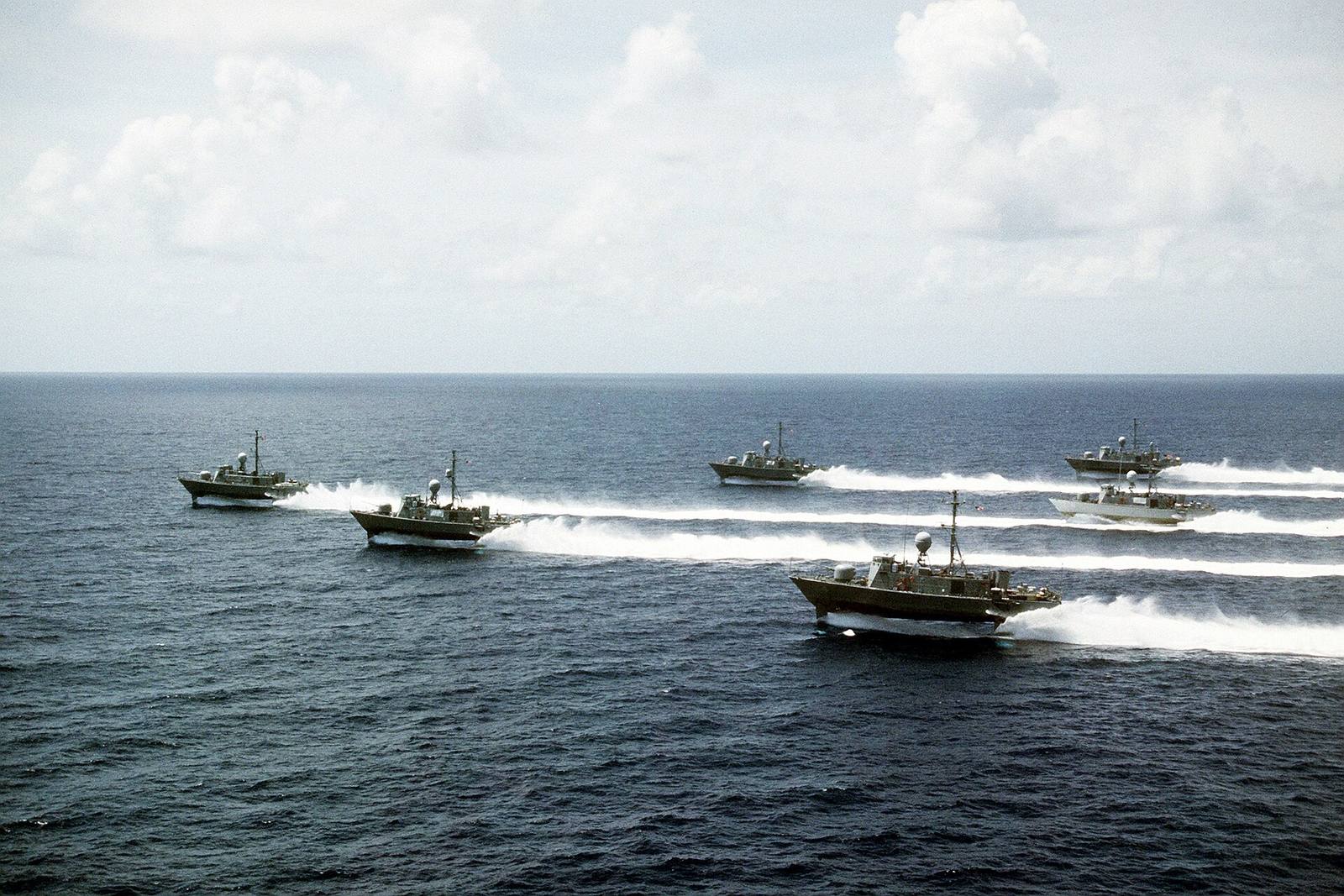
Fast ferries, patrol craft, hydrofoils, surface effect ships and other advanced marine vehicles are not simply faster versions of conventional ships. They demand lighter, stiffer structures, carefully chosen hull forms, rigorous seakeeping assessment and propulsion systems that can deliver very high power in a small space. This course explains how those decisions lock together. It introduces the lift-triangle framework for classifying vehicles by how they are supported, compares hull types against a high-speed operating brief, and shows how seakeeping criteria, wave statistics, slamming and human performance limits determine operability. It then examines the structural materials used in fast craft, from high-tensile steel to fibre-reinforced plastics, and finishes with waterjet propulsion, cavitation limits, engine matching, turbocharging and the use of gas turbines and fast diesels.
Course at a glance: Duration 20 hours · Self-paced online · 7 sections, 28 lessons, a 104-page downloadable course book
What you will learn
- Classify advanced marine vehicles using the lift-triangle framework of buoyancy, hydrodynamic lift and powered lift.
- Evaluate hull-form options such as planing hulls, catamarans, SWATH, hydrofoils and air-supported craft against an operating brief.
- Apply seakeeping criteria and wave statistics to judge fast-craft operability and motion limits.
- Explain slamming, deck wetness and human performance criteria such as motion sickness and task performance.
- Justify structural material choices using equivalent-safety, damage modelling and dynamic-response concepts.
- Describe waterjet selection, power flow, thrust and cavitation limits.
- Compare diesel and gas turbine propulsion and the principles of engine matching for fast craft.

Inside the course: a high-level summary, section by section.
Ship types and lift
The course begins by explaining why advanced marine vehicles differ from conventional ships. At high speed, resistance, motions, structural loads and power density become dominant design drivers, and the ordinary rules of thumb for merchant ships no longer apply. The lift-triangle framework provides a clear way to classify these craft according to how they are supported: by buoyancy, by hydrodynamic lift generated by forward motion, or by powered aerostatic lift from fans. Displacement hulls, planing hulls, hydrofoils, hovercraft and surface effect ships each sit near a corner, while hybrid concepts such as catamarans, foil-assisted catamarans and SWATH craft sit inside, combining support mechanisms.
Hull types are compared in terms of the trade-offs they offer. Some are chosen for ride quality and motion control in rough water; others to maximise speed or minimise resistance at a particular operating point. A ferry design case asks you to compare candidates on capacity delivered, speed sustained and the cost of achieving that performance in realistic sea conditions, showing that the right choice depends on the operating brief rather than on any single performance number. A vessel that is fastest in calm water may lose its advantage, or become uncomfortable, in the wave climate of its intended route.
Seakeeping criteria
For fast craft, seakeeping often determines whether a vessel can operate at all. The course explains how seakeeping criteria are grouped into categories covering the ship and its equipment, the cargo or payload, the crew and passengers, and the mission. Wave statistics turn a random sea into usable design quantities, connecting probabilistic descriptions of wave height and period to response measures such as accelerations, motions and the probability of extreme events.
Slamming and deck wetness are treated as key limiting phenomena for fast craft, where impacts can damage structure and equipment and deck wetness can make operations unsafe. Human performance criteria close the section, explaining how vertical accelerations and motion frequencies influence motion sickness and the ability of crew to perform tasks, and why these limits are often more restrictive than structural ones.
Structural materials
Advanced marine vehicles need structures that are lighter, stiffer and better understood than those of conventional ships. The course explains why designers move from ordinary mild steel to high-tensile steel, aluminium, hybrid combinations and fibre-reinforced plastics. Collapse behaviour and risk are discussed using the concept of risk as the product of probability and effect, and the idea of equivalent safety when new materials replace traditional ones. Damage models for fibre-reinforced plastics describe how material stiffness degrades as damage accumulates, and the course stresses that such models must be connected to laboratory tests and confirmed experimentally if predictions of post-peak behaviour are to be trusted. Dynamics and damping complete the section, because lightweight structures respond more strongly to slamming and vibration.


Waterjet propulsion
Waterjets are widely used on fast craft because they offer high efficiency at high speed, shallow draught, excellent manoeuvrability and protection from cavitation-induced propeller damage. The course places waterjets in historical and technical context and sets out selection criteria, including speed range, available hull space, weight and the interaction between the intake and the hull. Power flow and thrust are explained as a chain from engine power through the pump to the momentum of the jet, with overall propulsive efficiency as the central measure because it captures the full system, not just the pump.
Cavitation is a key limit. Different pump types, such as mixed-flow pumps and inducer-fitted pumps, have different cavitation boundaries, so the same suction specific speed can mean different things depending on the hardware. Testing methods for waterjets, from model tests to full-scale trials, round off the section.
Engines for fast craft
The final technical section deals with prime movers. Engine matching ensures that the engine, gearbox and propulsor work together across the operating range, avoiding overload at low speed or underuse of power at high speed. Turbocharging, including sequential arrangements, and selective catalytic reduction for nitrogen oxide control are explained in the context of high-performance diesels. Gas turbine basics show why their high power-to-weight ratio makes them attractive for the fastest vessels despite higher fuel consumption, and fast diesel concepts show how compact, high-speed engines meet the demands of many commercial and naval fast craft.
Why this matters in practice
Advanced marine vehicles operate close to their physical limits, so small design errors in weight, structure or propulsion can have large consequences for speed, safety and operability. Engineers who understand how hull support, seakeeping, structure and propulsion interact can make sounder decisions on concept selection, specification and procurement, and can assess claims made by builders and equipment suppliers more critically. The same reasoning applies whether the craft is a passenger ferry that must keep to a timetable in exposed waters, a crew transfer vessel serving offshore wind farms, or a naval patrol craft that must sustain speed and remain an effective platform for its crew. In each case, the best concept is the one that delivers the required capability across the realistic range of sea states and operating conditions, not the one with the highest calm-water top speed.
Key takeaways
You leave able to classify advanced marine vehicles, select hull forms for an operating brief, judge seakeeping and human performance limits, justify structural material choices and compare waterjet and engine options for fast craft.
How you study
The course is delivered fully online and is self-paced, so you can fit roughly 20 hours of study around professional commitments. Lessons combine clear explanation with examples, diagrams and short interactive checks, and the main sections end with graded quizzes (5 in total) so you can confirm you can apply each method before moving on. A 104-page course book can be downloaded and printed for offline reading and later reference.
Course contents
- Ship Types and Lift: Why AMVs Differ; The Lift Triangle; Hull Types Compared; Ferry Design Case
- Seakeeping Criteria: Criteria That Matter; Wave Statistics; Slamming and Deck Wetness; Human Performance
- Materials and Safety: Why Materials Change; Collapse and Risk; FRP Damage Models; Dynamics and Damping
- Waterjet Propulsion: Waterjets in Context; Selection Criteria; Power Flow and Thrust; Cavitation Limits; Testing Methods
- Engines and Matching: Matching Basics; Turbocharging and SCR; Gas Turbine Basics; Fast Diesel Concepts
- Summary: Key Takeaways
Who this course is for
This course is for engineering graduates and practising engineers working on fast ferries, patrol and naval craft, workboats, yachts and other high-speed vessels, including naval architects, marine engineers, structural engineers and procurement specialists. A background in basic hydrodynamics, structures and marine propulsion is helpful.
Frequently asked questions
How long does Design of Advanced Marine Vehicles take?
The course is designed for about 20 hours of study. It is self-paced and fully online, so you can spread it over a few weeks or complete it more quickly.
What is covered?
The course is organised into 7 sections with 28 lessons, moving from foundations to applied methods, as summarised above.
Is there material to keep after the course?
Yes. A downloadable 104-page course book accompanies the lessons for offline reading and later reference.
How is progress checked?
Each main section closes with a graded quiz (5 in total). The quizzes test understanding of the concepts and methods explained in the lessons rather than memorisation, and you can review the relevant lessons before attempting them.
Can I record this study for my own professional development?
Yes. The course notebook includes a self-assessment of the course objectives before and after study, a reflection page and a learning log, which you can use to keep your own record of professional development.
Duration: 20 hours
Related courses: B03 – Electrical Networks and Machines for Marine Applications; B05 – Piping Systems: Stress Analysis, Support and Expansion Design; A15 – Modularity and Platform-Based Ship Design; A06 – Ship Vibration and Noise
Enrol
Study at your own pace and work through the full course material, worked examples and section quizzes. Enrol in A14 – Design of Advanced Marine Vehicles →
Recent Comments