
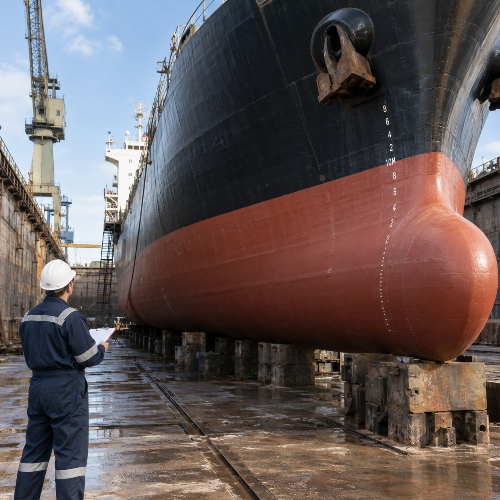
A18 – Naval Architecture Fundamentals
A postgraduate-level course in naval architecture built from the source documents, covering ship geometry, hydrostatics, stability, flooding, launching, and preliminary techno-economic ship design.
£299.00
2 hours 50 minutes
Focused, self-paced learning designed to fit around professional schedules.
Online, self-paced
Study online at a pace that fits your schedule.
10 sections
Structured curriculum sections.
English
Language of instruction for this course.
Quiz count: 5 total
Knowledge checks and assessed activities.
51 lessons
Focused lessons organised into a clear learning path.
Course overview
A postgraduate-level course in naval architecture built from the source documents, covering ship geometry, hydrostatics, stability, flooding, launching, and preliminary techno-economic ship design.
What you will learn
Describe ship hull geometry using lines-plan terminology and interpret the main hull-form coefficients and speed parameters.
Calculate centres of gravity, centroids, and displacement-related hydrostatic quantities from first principles and numerical methods.
Apply equilibrium, buoyancy, trim, and stability principles to analyse a vessel's floating condition and service problems.
Evaluate flooding, inclining, and launching problems using the methods presented in the source material.
Carry out preliminary technical and economic ship-design evaluations using the module's techno-economic framework.
Skills and knowledge
Naval architecture
Ship geometry
Hydrostatics
Stability analysis
Flooding
Ship design
Marine economics
Course curriculum
Introduction
1.1 Welcome
Ship Geometry and Design Context
2.1 Maritime Transport Context
2.2 Modes of Support
2.3 Design Requirements and Cycle
2.4 Lines Plans and Hull Terms
2.5 Comparative Design Parameters
2.6 Quiz 1 (quiz)
Mass, Moments and Integration
3.1 Mass and Weight Basics
3.2 Equivalent Forces and Couples
3.3 Centres of Gravity
3.4 Worked Vessel CG Example
3.5 Integration and Summation
3.6 Areas and Centroids
3.7 Standard Shape Families
3.8 Quiz 2 (quiz)
Buoyancy and Hydrostatics
4.1 Pressure and Hydrostatic Force
4.2 Archimedes and Equilibrium
4.3 Stability Concepts
4.4 Volumes and Centres of Buoyancy
4.5 Quiz 3 (quiz)
4.6 Hydrostatic Properties
Displacement, Trim and Numerical Methods
5.1 LCB, VCB and Sinkage
5.2 Second Moments and Metacentre
5.3 Simpson's Rules
5.4 Worked Hydrostatics Example
5.5 Draught and Trim Problems
5.6 Section 3 Assignment
Initial and Large-Angle Stability
6.1 Initial Stability Basics
6.2 Morrish and Munro-Smith
6.3 Virtual GG Losses
6.4 Wallsided Formula
6.5 Angles of Loll
6.6 Large-Angle Stability
6.7 Quiz 4 (quiz)
Flooding, Inclining and Launching
7.1 Flooding Methods
7.2 Flooding Worked Problems
7.3 Inclining Experiment
7.4 End Launching
7.5 Quiz 5 (quiz)
Preliminary Ship Design
8.1 Design Process Overview
8.2 Deadweight and Capacity Methods
8.3 Dimensions and Capacity Checks
8.4 Stability, Power and Lightship
8.5 Statutory and Class Framework
8.6 Section 6 Assignment
Ship Economics and Case Study
9.1 Operating and Construction Costs
9.2 Economic Evaluation Measures
9.3 Ship Design and Economic Comparison
9.4 Worked Design Case Study
9.5 Final Design Evaluation
Summary
10.1 Key Takeaways
Ready to enrol?
£299.00