
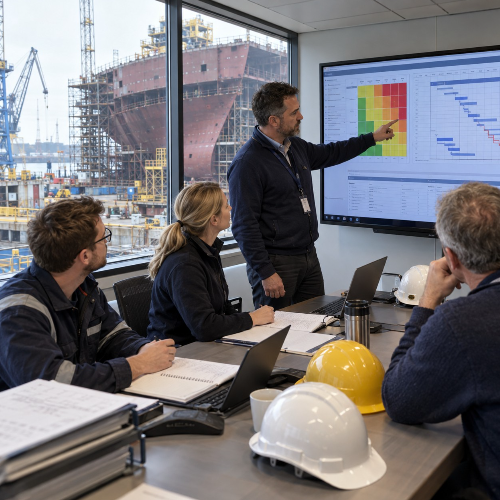
N03 – Project Risk Management for Maritime Projects
This course aims to develop practical skill in identifying, quantifying and managing risk in maritime engineering projects, using heuristic screening, Product Breakdown Structures, Potential Problem Analysis, FMEA, Root Cause Analysis and opportunity-focused project thinking through maritime examples.
£299.00
20 hours
Focused, self-paced learning designed to fit around professional schedules.
Online, self-paced
Study online at a pace that fits your schedule.
9 sections
Structured curriculum sections.
English
Language of instruction for this course.
43 lessons
Focused lessons organised into a clear learning path.
Course overview
Designed for: engineering graduates looking for refresher courses in niche expert areas.
Entry requirements: an engineering degree or equivalent experience; experience of working on, or alongside, engineering projects is helpful, and no prior training in risk management is needed.
Learning format: self-paced online lessons with audio read-out, worked examples (risk exposure, FMEA scoring and human failure probabilities), case studies (an ocean voyage, a design office and the Tenerife runway collision), five interactive decision scenarios, interactive tabs, flip cards and expandable panels, in-lesson checks, an AI tutor to answer questions as you go, and graded quizzes. This suits the aim because risk management is a practical skill, so worked examples, case studies and decision scenarios let you apply each method to a maritime project before you use it on your own work.
What you will learn
Define project risk and explain how probability, consequence, and buffer shape project exposure.
Apply heuristic questionnaires to surface weak boundary conditions early in a project.
Build a Product Breakdown Structure and use the three-colour method to screen work packages for risk.
Analyse project vulnerabilities using Potential Problem Analysis and Failure Mode and Effect Analysis.
Investigate incidents using Root Cause Analysis to identify root causes, failure mechanisms, and missing barriers.
Contrast risk-focused and opportunity-focused project thinking and select practical risk-management measures for maritime projects.
Skills and knowledge
Project risk management
Maritime projects
Heuristic screening
PBS
FMEA
Root cause analysis
Risk mitigation
Course curriculum
Introduction
1.1 Welcome
Risk Fundamentals
2.1 Projects and Constraints
2.2 Risk, Consequence and Buffer
2.3 Analysis and Management
2.4 Time, Cost and Quality
2.5 Risk Causes and Mindset
2.6 Quiz 1
Heuristic Screening
3.1 The Five-Step Method
3.2 Boundary Conditions
3.3 Questionnaire Categories
3.4 Ocean Voyage Example
3.5 Quiz 2
PBS and Colour Screening
4.1 What a PBS Does
4.2 Deliverables and Management Products
4.3 Building a PBS
4.4 The Three-Colour Method
4.5 Design Office Case
4.6 Quiz 3
PPA and FMEA
5.1 Potential Problem Analysis
5.2 Writing Risk Statements
5.3 FMEA and Guide Words
5.4 Scoring Risk Three Ways
5.5 Human Failure Probabilities
5.6 Worked FMEA Example
5.7 Quiz 4
Root Cause Analysis
6.1 Beyond the First Symptom
6.2 Describing the Problem
6.3 Event and Cause Chains
6.4 Mechanisms and Barriers
6.5 Tenerife Case
6.6 Quiz 5
Risk and Opportunity Thinking
7.1 Two Project Mindsets
7.2 Potential Opportunity Analysis
7.3 Opportunity Example
7.4 Comparing the Mindsets
7.5 Quiz 6
Putting Risk Into Practice
8.1 Why, When and Who
8.2 Cost and Risk Reduction
8.3 Building a Risk Log
8.4 Mitigation Categories
8.5 Integrated Risk Practice
8.6 Quiz 7
Summary
9.1 Key Takeaways
Ready to enrol?
£299.00