
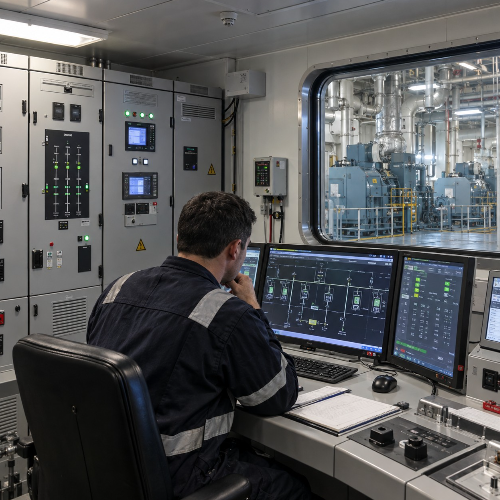
J02 – FEP System Design for a Dual-Role Tanker
This course prepares marine electrical engineering students to develop and justify an integrated full electrical propulsion design for a dual-role tanker. It combines the vessel design requirements with the core electrical, machine, power-electronic, and marine propulsion theory needed to complete the design work and supporting calculations.
£299.00
1 hour 10 minutes
Focused, self-paced learning designed to fit around professional schedules.
Online, self-paced
Study online at a pace that fits your schedule.
9 sections
Structured curriculum sections.
English
Language of instruction for this course.
24 lessons
Focused lessons organised into a clear learning path.
Course overview
This course prepares marine electrical engineering students to develop and justify an integrated full electrical propulsion design for a dual-role tanker. It combines the vessel design requirements with the core electrical, machine, power-electronic, and marine propulsion theory needed to complete the design work and supporting calculations.
What you will learn
Interpret the tanker’s operating profile, load cases, and design constraints for an IFEP proposal.
Apply core DC, AC, and three-phase electrical principles to marine power-system calculations.
Compare machines, converters, distribution arrangements, and prime-mover options for shipboard electrical propulsion.
Design a justified IFEP architecture and single-line diagram for the specified vessel.
Estimate fuel use, operating cost, losses, and emissions across the vessel’s operating range.
Skills and knowledge
Marine electrical systems
IFEP design
Three-phase power
Power electronics
Ship propulsion
Fuel and emissions
Electrical losses
Single-line diagrams
Course curriculum
Introduction
1.1 Welcome
Design Brief
2.1 Vessel Mission
2.2 Power Demands
2.3 Required Outputs
Electrical Basics
3.1 Core Quantities
3.2 Circuit Laws
3.3 Equivalent Networks
AC Power Systems
4.1 AC Fundamentals
4.2 Three-Phase Power
4.3 Per-Unit Faults
Machines and Drives
5.1 Transformers
5.2 Motors Generators
5.3 Power Electronics
Marine Architecture
6.1 Propulsion Chain
6.2 Distribution Options
6.3 Prime Movers
IFEP Design
7.1 Load Cases
7.2 Equipment Sizing
7.3 Single-Line Diagram
Performance Review
8.1 Fuel Modeling
8.2 Operating Cost
8.3 Losses Emissions
8.4 Supporting Evidence
Summary
9.1 Key Takeaways
Ready to enrol?
£299.00