
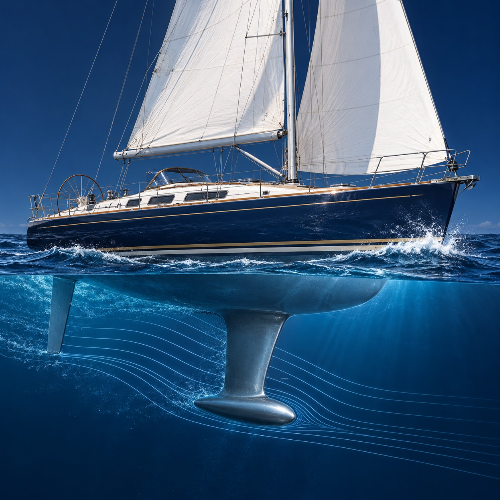
I01 – Sail Yacht Design and Technology
A course on sail yacht stability, hydrodynamics, seakeeping and experimental testing: how hull form, appendages, waves and test methods shape yacht performance and safety.
£299.00
20 hours
Focused, self-paced learning designed to fit around professional schedules.
Online, self-paced
Study online at a pace that fits your schedule.
6 sections
Structured curriculum sections.
English
Language of instruction for this course.
18 lessons
Focused lessons organised into a clear learning path.
Course overview
Relevance to CPD: Refreshes the stability, resistance, seakeeping and model-testing knowledge that naval architects and yacht designers use when assessing sailing-yacht safety and performance.
1. Explain how righting moment and GZ curves are used to assess yacht stability.
Designed for: engineering graduates looking for refresher courses in niche expert areas.
Entry requirements: an engineering degree or equivalent experience, plus familiarity with basic hydrostatics and fluid mechanics (centres of gravity and buoyancy, Reynolds and Froude numbers); no prior yacht-design study is assumed.
What you will learn
Explain how righting moment and GZ curves are used to assess yacht stability.
Analyse the main components of calm-water resistance and the design choices that reduce them.
Evaluate how waves and mass distribution influence yacht performance in head seas and following seas.
Compare resistance-prediction and validation methods including systematic series, CFD, and model testing.
Interpret how hull form, appendage geometry, and testing data inform yacht design decisions.
Skills and knowledge
Yacht stability
Hydrodynamics
Resistance prediction
Seakeeping
Model testing
Naval architecture
Course curriculum
Introduction
1.1 Welcome
Stability and Safety
2.1 Righting Moment Basics
2.2 Reading GZ Curves
2.3 Capsize and Re-righting
2.4 Quiz 1
Hydrodynamics and Resistance
3.1 Resistance Prediction Methods
3.2 Friction and Wave Drag
3.3 Heel, Side Force, and Leeway
3.4 Hull Form and Delft Series
3.5 Quiz 2
Performance in Waves
4.1 Wave Environment and RAW
4.2 Yacht Model Study Findings
4.3 Following Seas Simulation
4.4 Quiz 3
Model Testing
5.1 Facilities and Campaign Choices
5.2 Semi-captive Testing
5.3 Quiz 4
Summary
6.1 Key Takeaways
Ready to enrol?
£299.00