
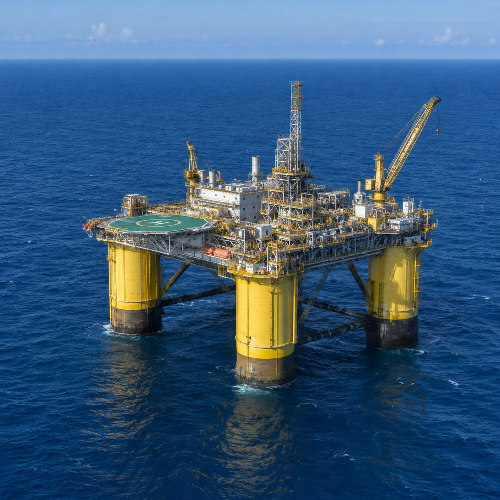
D08 – Floating Structures
This course aims To cover the design and selection of floating offshore structures, from FPSOs and semi-submersibles to spars, TLPs, FLNG and installation.
£299.00
20 hours
Focused, self-paced learning designed to fit around professional schedules.
Online, self-paced
Study online at a pace that fits your schedule.
15 sections
Structured curriculum sections.
English
Language of instruction for this course.
Quiz count: 13 total
Knowledge checks and assessed activities.
58 lessons
Focused lessons organised into a clear learning path.
Course overview
Relevance to CPD: Refreshes the selection, sizing and safety judgement engineers apply to floating structures.
1. Select and justify a floating or hybrid structure type for a given duty and environment.
Designed for: engineering graduates looking for refresher courses in niche expert areas.
Entry requirements: an engineering degree or equivalent experience, plus basic hydrostatics (buoyancy and stability).
What you will learn
Select an appropriate floating or hybrid offshore structure type for a given function, water depth, and environment, and justify the choice using engineering criteria.
Perform first-order displacement, lightship, and deadweight calculations to size a floating structure from payload and operational requirements.
Develop preliminary layout and sizing decisions for FPSOs, semi-submersibles, and spar platforms using the course design drivers and hydrostatic checks.
Evaluate offshore safety risks using hazard identification, risk matrices, ALARP, and safety-case reasoning grounded in historical accident lessons.
Assess mooring, riser, loading, transport, and installation concepts for their suitability to different floating offshore applications.
Critique how floating offshore technologies are adapted through conversions, capability upgrades, and emerging energy applications.
Skills and knowledge
Floating structures
Hydromechanics
FPSO design
Semi-submersibles
Spar platforms
Mooring systems
Risk assessment
Marine installation
Course curriculum
Introduction
1.1 Welcome
Safety Culture and Risk Fundamentals
2.1 Safety as Design Driver
2.2 Risk Metrics and Reporting
2.3 Safety Systems and ALARP
2.4 Major Accident Lessons
2.5 Quiz 1 (quiz)
Design Process and Floating Structure-Type Selection
3.1 Mission Profiles and Types
3.2 Water Depth and Hull Choice
3.3 Marine Design Process
3.4 Floater Design Constraints
3.5 Quiz 2 (quiz)
Floater Carrying Capacity and Platform Supply Vessel Design
4.1 Displacement and Weight Breakdown
4.2 PSV Functions and Hazards
4.3 Exercise 1 Brief
4.4 IMT990 and Design Trends
4.5 PSV Concept Design
4.6 Quiz 3 (quiz)
FPSO Layout, Systems and Real Projects
5.1 FPSO Concepts and Rationale
5.2 FPSO Design Drivers
5.3 Storage and Hull Sizing
5.4 Layout, Turret and Offloading
5.5 Exercise 2 Brief
5.6 Project Case Studies
5.7 Preliminary FPSO Design
5.8 Quiz 4 (quiz)
FPSO Safety Case and Formal Safety Assessment
6.1 Safety Case Framework
6.2 Hazard Identification and HIRA
6.3 ALARP and Risk Reduction
6.4 Safety-Case Assessment
6.5 Quiz 5 (quiz)
Offshore Loading and Offloading Systems
7.1 Offloading Arrangements
7.2 Operability and Safeguards
7.3 Quiz 6 (quiz)
Jack-Up Platforms and Hybrid Offshore Structures
8.1 Jack-Up Fundamentals
8.2 Verification and Hybrid Use
8.3 Quiz 7 (quiz)
Semi-Submersibles: Functions, Stability and Motion
9.1 Semi-Submersible Functions
9.2 Hydrostatics and Heave
9.3 Semi-Sub Outline Design
9.4 Quiz 8 (quiz)
Spar Platforms
10.1 Spar Concepts and Types
10.2 Hydromechanics and Heave
10.3 Classic Spar Design
10.4 Quiz 9 (quiz)
Mooring Systems, Risers and Tension Leg Platforms
11.1 Mooring System Types
11.2 Risers and Interfaces
11.3 TLP Behaviour
11.4 Quiz 10 (quiz)
Floating LNG (FLNG)
12.1 FLNG Process Integration
12.2 FLNG Hull Considerations
12.3 Quiz 11 (quiz)
Capability Upgrades, Conversions and Emerging Floating Technologies
13.1 Capability Upgrades
13.2 Emerging Floating Applications
13.3 Quiz 12 (quiz)
Marine Transportation and Installation of Floating Structures
14.1 Transport Strategies
14.2 Installation Campaigns
14.3 Quiz 13 (quiz)
Summary
15.1 Key Takeaways
Ready to enrol?
£299.00