
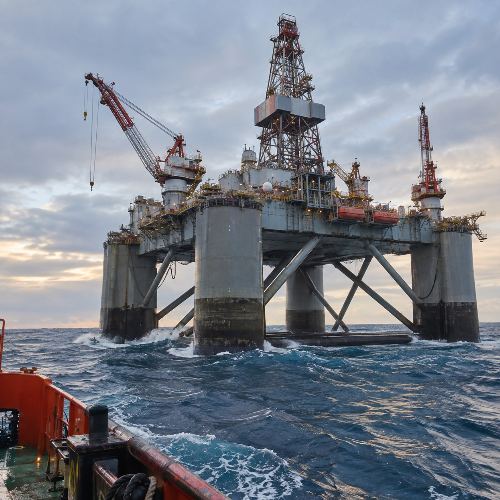
D05 – Offshore Hydromechanics
A master's-level course in offshore hydromechanics covering hydrostatics and stability, potential and real flow theory, ocean-wave mechanics, floating-body motions and loads, station keeping, extreme responses, slender-structure loading, and fatigue concepts for offshore engineering applications.
£299.00
3 hours 58 minutes
Focused, self-paced learning designed to fit around professional schedules.
Online, self-paced
Study online at a pace that fits your schedule.
15 sections
Structured curriculum sections.
English
Language of instruction for this course.
Quiz count: 13 total
Knowledge checks and assessed activities.
80 lessons
Focused lessons organised into a clear learning path.
Course overview
A master's-level course in offshore hydromechanics covering hydrostatics and stability, potential and real flow theory, ocean-wave mechanics, floating-body motions and loads, station keeping, extreme responses, slender-structure loading, and fatigue concepts for offshore engineering applications.
What you will learn
Carry out hydrostatic and floating-stability calculations for floating offshore structures, including free-surface and load-shift effects.
Apply potential-flow and real-flow concepts to explain hydrodynamic loads, resistance, and propulsion behavior.
Analyse regular and irregular waves using linear wave theory, spectra, and wave statistics.
Evaluate floating-body motions, RAOs, and wave loads using first-order hydrodynamic theory.
Predict offshore structural response, drift forces, station-keeping performance, and design loads in irregular seas.
Apply Morison-equation loading and basic fatigue and stress-concentration concepts to slender offshore members and joints.
Skills and knowledge
Hydrostatics
Floating stability
Potential flow
Wave theory
RAOs
Station keeping
Morison equation
Fatigue
Course curriculum
Introduction
1.1 Welcome
Hydrostatics and Stability
2.1 Hydrostatic Pressure and Buoyancy
2.2 Centers and Metacentric Height
2.3 Heel Effects and Scribanti
2.4 Free Surface and Inclining
2.5 Pontoon Loading Example
2.6 Section Quiz (quiz)
Potential Flow Theory
3.1 Potential and Stream Functions
3.2 Elementary Flow Elements
3.3 Superposition and Canonical Bodies
3.4 D'Alembert and Images
3.5 Cylinder Near a Wall
3.6 Section Quiz (quiz)
Real Flow, Resistance and Propulsion
4.1 Viscosity and Separation
4.2 Scaling and Model Tests
4.3 Resistance Extrapolation Methods
4.4 Propeller Performance
4.5 Cavitation and VIV
4.6 Section Quiz (quiz)
Regular Waves and Linear Theory
5.1 Wave Boundary-Value Problem
5.2 Dispersion Relation
5.3 Particle Kinematics
5.4 Wave Energy and Group Velocity
5.5 Dispersion Worked Example
5.6 Section Quiz (quiz)
Irregular Waves and Spectra
6.1 Sea States and Random Waves
6.2 Spectral Description
6.3 Common Wave Spectra
6.4 Statistics of Wave Heights
6.5 Spectral Offshore Application
6.6 Section Quiz (quiz)
Floating-Body Motions and RAOs
7.1 Six Degrees of Freedom
7.2 Equations of Motion
7.3 Hydrodynamic Coefficients
7.4 Response Amplitude Operators
7.5 RAO Data Example
7.6 Section Quiz (quiz)
Wave Loads on Floating Bodies
8.1 Wave Excitation Concepts
8.2 Froude-Krylov Force
8.3 Diffraction and Radiation
8.4 Computing Loads and Moments
8.5 Worked Load Interpretation
8.6 Section Quiz (quiz)
Response in Irregular Waves
9.1 Spectral Response Framework
9.2 Short-Term Response Statistics
9.3 Derived Responses and Loads
9.4 Workability and Downtime
9.5 Offshore Operability Example
9.6 Section Quiz (quiz)
Second-Order Wave Drift Forces
10.1 Why Second-Order Loads Matter
10.2 Near- and Far-Field Methods
10.3 QTF and Newman's Approximation
10.4 Low-Frequency Motions
10.5 Drift Force Case Study
10.6 Section Quiz (quiz)
Station Keeping
11.1 Station-Keeping Principles
11.2 Catenary Mooring Systems
11.3 Dynamic Positioning Systems
11.4 Mooring versus DP
11.5 Station-Keeping Example
11.6 Section Quiz (quiz)
Extreme Value Statistics
12.1 Why Extremes Matter
12.2 Short-Term Maxima Models
12.3 Design Loads from Exceedance
12.4 Simulation Duration and Reliability
12.5 Extreme Load Case
12.6 Section Quiz (quiz)
Morison Equation and Piles
13.1 Slender-Body Loading Regime
13.2 Morison Equation Terms
13.3 Keulegan-Carpenter Effects
13.4 Variable-Diameter Piles
13.5 Pile Loading Example
13.6 Section Quiz (quiz)
Fatigue and Stress Concentration
14.1 Fatigue in Offshore Structures
14.2 Stress Concentration Factors
14.3 Tubular Joint Behavior
14.4 Hydrodynamics to Fatigue Chain
14.5 SCF Application Example
14.6 Section Quiz (quiz)
Summary
15.1 Key Takeaways
Ready to enrol?
£299.00