
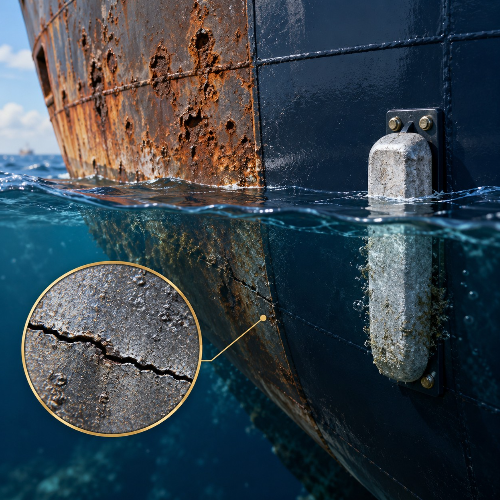
C08 – Structural and Material Response to the Marine Environment
A course covering electrochemical corrosion, seawater chemistry, general ship corrosion, and localised attack mechanisms. Fracture/fatigue and process-plant topics referenced in the overview are noted but not expanded here because those teaching chapters were not attached.
£299.00
1 hour
Focused, self-paced learning designed to fit around professional schedules.
Online, self-paced
Study online at a pace that fits your schedule.
7 sections
Structured curriculum sections.
English
Language of instruction for this course.
Quiz count: 4 total
Knowledge checks and assessed activities.
22 lessons
Focused lessons organised into a clear learning path.
Course overview
A course covering electrochemical corrosion, seawater chemistry, general ship corrosion, and localised attack mechanisms. Fracture/fatigue and process-plant topics referenced in the overview are noted but not expanded here because those teaching chapters were not attached.
What you will learn
Explain aqueous corrosion as an electrochemical process and relate corrosion current to metal loss.
Calculate equilibrium electrode potentials with the Nernst equation and interpret mixed-potential behaviour.
Analyse how seawater composition, pH, dissolved gases, scale formation, and biofouling influence corrosion risk.
Diagnose general corrosion conditions in ship structures, ballast tanks, and cargo tanks.
Distinguish major localised corrosion mechanisms in marine systems and explain the conditions that promote them.
Summarise the documented module scope and assessment pattern in the attached archive.
Skills and knowledge
Marine corrosion
Electrochemistry
Seawater chemistry
Ship structures
Localised corrosion
Materials response
Course curriculum
Introduction
1.1 Welcome
Module Context
2.1 Course Scope
2.2 Assessment Structure
Corrosion Fundamentals
3.1 Electrochemical Cells
3.2 Nernst Equation
3.3 Polarisation and Rate
3.4 Fundamentals Quiz (quiz)
Seawater Chemistry
4.1 Seawater Composition
4.2 pH and Dissolved Gases
4.3 Scale and Biofouling
4.4 Seawater Quiz (quiz)
General Corrosion in Ships
5.1 Passivity and Oxygen Control
5.2 Environmental Effects
5.3 Shipboard Corrosion Zones
5.4 General Corrosion Quiz (quiz)
Localised Corrosion
6.1 Galvanic Corrosion
6.2 Pitting and Crevices
6.3 Intergranular Attack
6.4 MIC and Stray Current
6.5 Erosion, SCC, and Hydrogen
6.6 Localised Corrosion Quiz (quiz)
Summary
7.1 Key Takeaways
Ready to enrol?
£299.00