
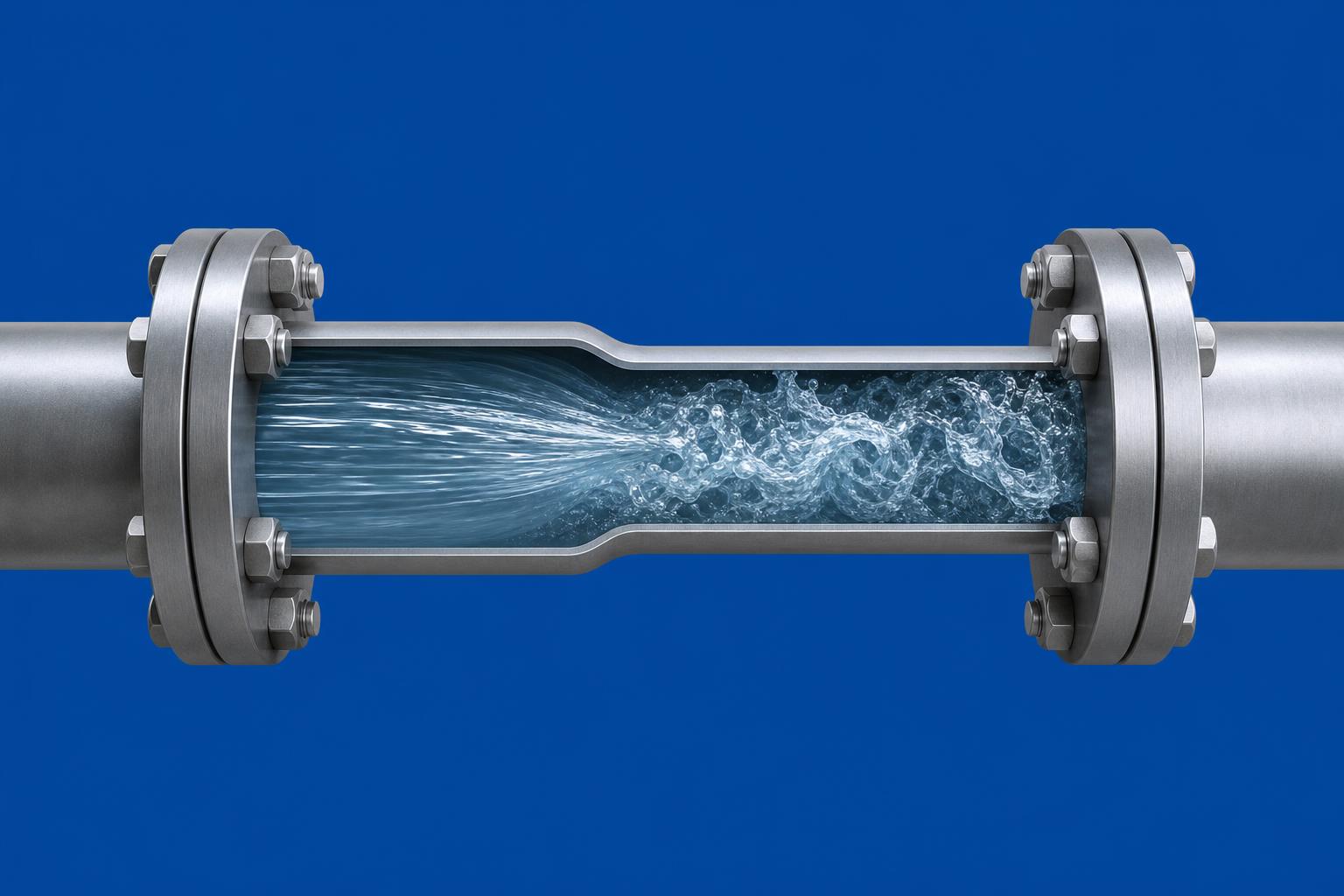
C05 – Fluid Mechanics: Pipe Flow & Pressure Loss
Introduce viscous fluid flow in pipes, focusing on friction losses, local losses, friction-factor selection, and the analysis of practical single-pipe and pipe-network systems using standard fluid-mechanics methods.
£299.00
20 hours
Focused, self-paced learning designed to fit around professional schedules.
Online, self-paced
Study online at a pace that fits your schedule.
8 sections
Structured curriculum sections.
English
Language of instruction for this course.
Quiz count: 4 total
Knowledge checks and assessed activities.
43 lessons
Focused lessons organised into a clear learning path.
Course overview
Designed for: engineering graduates looking for refresher courses in niche expert areas.
Entry requirements: an engineering degree or equivalent experience, plus basic fluid properties, Bernoulli's equation and algebra; a calculator or spreadsheet for iterative friction-factor and network solutions.
What you will learn
Explain how viscosity causes energy loss in pipe flow and relate head loss to the extended Bernoulli equation.
Classify pipe flow using the Reynolds number and apply the laminar-flow friction relationship.
Apply the Darcy-Weisbach equation to calculate head loss and pressure drop in pipe systems.
Determine an appropriate friction factor using the Moody chart, empirical equations, and representative roughness data.
Quantify local losses for common fittings and transitions using loss coefficients.
Analyze single pipelines and simple pipe networks to solve for flow rate, head loss, pressure, or junction conditions.
Skills and knowledge
Pipe flow
Head loss
Darcy-Weisbach
Moody chart
Friction factor
Minor losses
Pipe networks
Course curriculum
Introduction
1.1 Welcome
Real Fluid Flow
2.1 Viscosity and Shear Stress
2.2 Extended Bernoulli Equation
2.3 Reynolds Number and Regimes
2.4 Laminar Pipe Flow
2.5 Design Problem Types
2.6 Quiz 1 (quiz)
Darcy-Weisbach Losses
3.1 Force Balance in a Pipe
3.2 General Darcy-Weisbach Derivation
3.3 Friction Factor Conventions
3.4 Discharge Form of Darcy-Weisbach
3.5 Physical Dependencies of Loss
3.6 Laminar Friction Factor
3.7 Quiz 2 (quiz)
Friction Factor Selection
4.1 What Controls Friction Factor
4.2 Nikuradse's Findings
4.3 Reading the Moody Chart
4.4 Colebrook-White Equation
4.5 Explicit Approximations
4.6 Typical Roughness Values
4.7 Quiz 3 (quiz)
Local Losses
5.1 Major and Minor Losses
5.2 Loss-Coefficient Form
5.3 Sudden Enlargement Loss
5.4 Sudden Contraction Loss
5.5 Boundary-Layer Separation
5.6 Typical Fitting Coefficients
5.7 Quiz 4 (quiz)
Single-Pipeline Analysis
6.1 Energy Equation for Pipelines
6.2 Pressure Drop and Head Loss
6.3 Finding Flow Rate
6.4 Finding Pipe Diameter
6.5 Intermediate Pressure Points
6.6 Hydraulic and Total Head Lines
6.7 Worked Pipeline Method
6.8 Quiz 5
Pipe Networks
7.1 Pipes in Series
7.2 Pipes in Parallel
7.3 Branched Pipe Networks
7.4 Iterative Solution Methods
7.5 Network Analysis Workflow
7.6 Quiz 6
Summary
8.1 Key Takeaways
Ready to enrol?
£299.00