
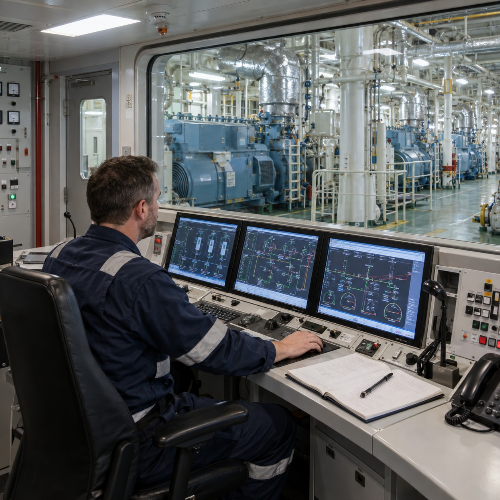
B13 – Marine Engineering — Propulsion, Auxiliary Systems & Control Engineering
This course aims to cover propulsion, auxiliary systems, thermodynamics, fluid mechanics, control, transmission and ship resistance through worked engineering applications, so you can relate marine engineering to naval architecture and analyse ship systems as one integrated whole.
£299.00
20 hours
Focused, self-paced learning designed to fit around professional schedules.
Online, self-paced
Study online at a pace that fits your schedule.
9 sections
Structured curriculum sections.
English
Language of instruction for this course.
Quiz count: 6 total
Knowledge checks and assessed activities.
34 lessons
Focused lessons organised into a clear learning path.
Course overview
Designed for: engineering graduates looking for refresher courses in niche expert areas.
Entry requirements: an engineering degree or equivalent experience, plus a working knowledge of engineering thermodynamics and fluid mechanics at first-degree level.
Learning format: self-paced online lessons with audio read-out, worked examples, an applied case study, a worked-answers review lesson, interactive tabs and flip cards, in-lesson checks, an AI tutor to answer questions as you go, and graded quizzes. This suits the aim because the course spans many subsystems, so short worked applications and checks keep each idea tied to real ship decisions before moving on.
What you will learn
Define the role of the marine engineer and relate marine engineering to naval architecture in ship design.
Explain how propulsion, auxiliary, and control systems interact within a ship as a system of systems.
Apply core thermodynamics and fluid-mechanics principles to marine engineering problems.
Analyse major marine-engineering subsystems including propulsion plant, auxiliary services, and transmission systems.
Evaluate ship resistance, propulsion prediction, and control concepts using established engineering methods.
Apply integrated marine-engineering knowledge to engine and propeller matching problems.
Skills and knowledge
Marine engineering
Propulsion systems
Auxiliary systems
Control systems
Thermodynamics
Fluid mechanics
Ship resistance
Propeller matching
Course curriculum
Introduction
1.1 Welcome
Marine Engineering Foundations
2.1 The Marine Engineer’s Role
2.2 Design Drivers and Constraints
2.3 Marine Engineering in Context
2.4 Quiz 1 (quiz)
Propulsion Systems
3.1 Ship Powering Concept
3.2 Prime Movers and Electric Drive
3.3 Propulsors and Transmission
3.4 Fuel and Propulsive Efficiency
3.5 Quiz 2 (quiz)
Auxiliary and Control Systems
4.1 Auxiliary Systems Framework
4.2 Propulsion Support Services
4.3 Hotel, Safety, and Environmental Systems
4.4 Control and Management Systems
4.5 Deck Machinery and Estimation
4.6 Quiz 3 (quiz)
Engineering Fundamentals
5.1 Thermodynamics Essentials
5.2 Fluid Mechanics Essentials
5.3 Quiz 4 (quiz)
Major Fields of Study
6.1 Diesel Engines
6.2 Steam Plant and Rankine Cycle
6.3 Heat Exchangers
6.4 Refrigeration
6.5 Propeller Theory
6.6 Linear Control Theory
6.7 Quiz 5 (quiz)
Advanced Marine Applications
7.1 Transmission Systems
7.2 Resistance and Seakeeping
7.3 Engine and Propeller Matching
7.4 Supplementary Topics
7.5 Applied Case Study
7.6 Quiz 6 (quiz)
Answer Key and Review
8.1 Worked Answers Review
Summary
9.1 Key Takeaways
Ready to enrol?
£299.00