
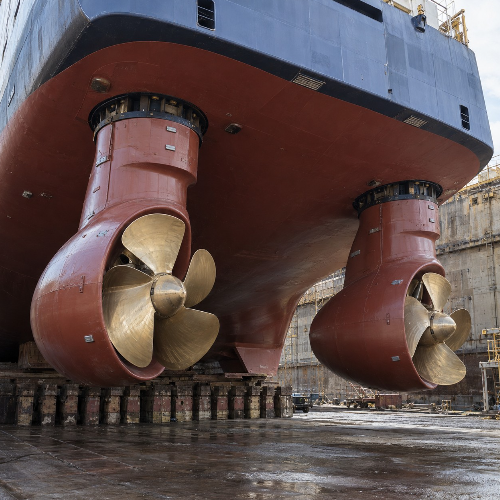
B11 – Marine Propulsors: Thrusters, Pods and Waterjets
This course aims to cover tunnel thrusters, steerable thrusters, podded propulsors and waterjets - their engineering principles, formulas, selection criteria and worked examples - so you can choose and size the right propulsor for a vessel duty.
£299.00
20 hours
Focused, self-paced learning designed to fit around professional schedules.
Online, self-paced
Study online at a pace that fits your schedule.
9 sections
Structured curriculum sections.
English
Language of instruction for this course.
41 lessons
Focused lessons organised into a clear learning path.
Course overview
Designed for: engineering graduates looking for refresher courses in niche expert areas.
Entry requirements: an engineering degree or equivalent experience, plus a working knowledge of propeller basics, mechanics and machine elements (gears and bearings).
Learning format: self-paced online lessons with audio read-out, worked examples (thruster sizing and bearing life), interactive tabs, in-lesson checks, an AI tutor to answer questions as you go, and graded quizzes. This suits the aim because propulsor selection depends on applying sizing rules to a real duty, so worked sizing and bearing-life examples sit next to the theory.
What you will learn
Explain why different marine propulsor types are selected for specific manoeuvring and propulsion duties.
Apply tunnel-thruster design rules to assess tunnel geometry, installation limits, and expected thrust delivery.
Analyze how forward speed, interaction effects, noise, and cyclic loading influence transverse-thruster performance.
Calculate core sizing loads for steerable thrusters, including torque, bending moment, and steering moment.
Evaluate propeller, nozzle, gearbox, and bearing design choices for mechanically geared thrusters.
Compare podded and waterjet propulsion concepts against conventional shafted arrangements for appropriate vessel duties.
Skills and knowledge
Tunnel thrusters
Thruster performance
Azimuth thrusters
Propulsor design
Gear and bearing selection
Podded propulsion
Waterjet systems
Course curriculum
Course Overview
1.1 Course Introduction
1.2 What this course covers
Why Transverse Thrusters, and Basic Tunnel Design
2.1 Learning objectives
2.2 The case for a transverse thruster
2.3 Typical applications and market segments
2.4 Product configurations
2.5 How the tunnel itself affects performance
2.6 Design guidelines for tunnel geometry and grids
2.7 Quiz 1
Transverse Thruster Performance - Forward Speed, Interaction and Loads
3.1 Learning objectives
3.2 Effect of forward ship speed
3.3 The anti-suction tunnel
3.4 Interaction between multiple thrusters
3.5 Non-dimensional performance description
3.6 Noise
3.7 Dynamic loads: idling versus powered operation, and fatigue
3.8 Quiz 2
Steerable Thrusters - Applications and Selection
4.1 Learning objectives
4.2 Why fit a steerable thruster?
4.3 Typical applications
4.4 Thruster families and power range
4.5 L-drive versus Z-drive
4.6 Sizing the thruster: torque, bending moment and steering moment
4.7 Thruster Sizing Worked Example
4.8 Quiz 3
Steerable Thruster Design - Propellers, Nozzles, Gearing and Bearings
5.1 Learning objectives
5.2 Controllable-pitch versus fixed-pitch propellers
5.3 Why (almost) every thruster uses a nozzle
5.4 Pulling versus pushing arrangements
5.5 Mechanical design of the gearing and steering system
5.6 Bearing types and selection
5.7 Bearing life calculation
5.8 Bearing Life Worked Example
5.9 Quiz 4
Podded Propulsion Systems
6.1 Podded Propulsion Systems
6.2 Quiz 5
Waterjet Propulsion Fundamentals
7.1 Waterjet Propulsion Fundamentals
7.2 Quiz 6
Waterjet Selection, Pumps and Operating Performance
8.1 Waterjet Selection, Pumps and Operating Performance
8.2 Quiz 7
Summary
9.1 Key Takeaways
Ready to enrol?
£299.00