
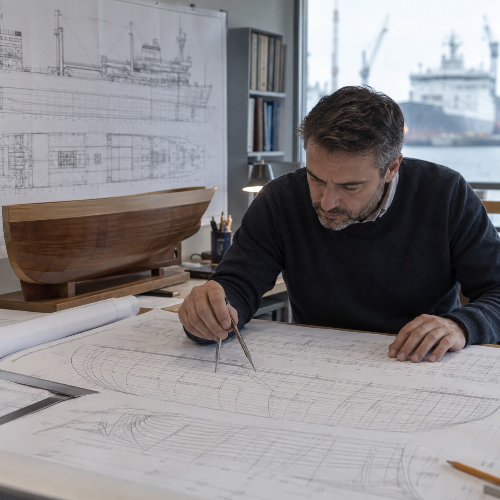
A12 – Naval Architecture and Ship Production Technology (Part 3 of 4)
This course introduces the preliminary-design methods used to estimate ship form, weight, resistance, cost, and specialized design features before detailed design begins. It also covers core CAD and geometric-modeling concepts, hull alteration methods, and gas-carrier design fundamentals.
£299.00
1 hour 55 minutes
Focused, self-paced learning designed to fit around professional schedules.
Online, self-paced
Study online at a pace that fits your schedule.
8 sections
Structured curriculum sections.
English
Language of instruction for this course.
40 lessons
Focused lessons organised into a clear learning path.
Course overview
This course introduces the preliminary-design methods used to estimate ship form, weight, resistance, cost, and specialized design features before detailed design begins. It also covers core CAD and geometric-modeling concepts, hull alteration methods, and gas-carrier design fundamentals.
What you will learn
Estimate preliminary hull-form coefficients from regression-based methods.
Break down lightship weight, deadweight, and resistance components for concept-stage design decisions.
Compare cost, crew, and operating-economics models used in early ship evaluation.
Explain how CAD, geometric transformations, and parametric curves support hull and arrangement development.
Assess hull alteration methods, rudder and appendage options, and gas-carrier containment choices.
Skills and knowledge
Hull coefficients
Weight estimation
Ship economics
CAD fundamentals
Hull alteration
Rudder design
Gas carriers
General arrangement
Course curriculum
Introduction
1.1 Welcome
Preliminary Estimation
2.1 Hull Coefficient Regressions
2.2 Preliminary Weight Groups
2.3 Deadweight and Iteration
2.4 Holtrop and Mennen
2.5 Container Capacity Estimates
2.6 Quiz 1
Ship Economics
3.1 Newbuilding Cost Groups
3.2 Crew Cost Models
3.3 Operating Cost Formulae
3.4 Required Freight Rate
3.5 Flag and Registry
3.6 Quiz 2
CAD and Hull Modeling
4.1 From Offsets to NURBS
4.2 Hull Modeling Workflow
4.3 CAD Coordinates and Layers
4.4 Model and Paper Space
4.5 Drawing Standards
4.6 Quiz 3
Geometry and GA
5.1 Geometric Transformations
5.2 Transformation Order
5.3 Bezier Curve Basics
5.4 de Casteljau Method
5.5 General Arrangement
5.6 Quiz 4
Hull Alteration and Appendages
6.1 Alteration Goals
6.2 Classical Alteration Methods
6.3 Parallel Mid-Body
6.4 Worked Alteration Cases
6.5 Rudder Types
6.6 Profiles and Torque
6.7 Bilge Keels
6.8 Quiz 5
Gas Carrier Design
7.1 Gas Trade Context
7.2 LNG Containment Systems
7.3 IGC Tank Classes
7.4 LPG Specifications
7.5 Terminal Interface
7.6 Quiz 6
Summary
8.1 Key Takeaways
Ready to enrol?
£299.00