
A11 – Naval Architecture and Ship Production Technology (Part 2 of 4)
This course aims to show how international conventions and casualty experience drive the design of the main merchant ship types, and how hull form and bulbous bow concepts are used to judge design trade-offs, so you can read a design through both its rules and its hydrodynamics.
£299.00
20 hours
Focused, self-paced learning designed to fit around professional schedules.
Online, self-paced
Study online at a pace that fits your schedule.
7 sections
Structured curriculum sections.
English
Language of instruction for this course.
Quiz count: 5 total
Knowledge checks and assessed activities.
30 lessons
Focused lessons organised into a clear learning path.
Course overview
Designed for: engineering graduates looking for refresher courses in niche expert areas.
Entry requirements: an engineering degree or equivalent experience, plus Part 1 of this series or equivalent knowledge of the ship design process, classification societies and the IMO framework, and basic ship stability (metacentric height and GZ).
Learning format: self-paced online lessons with audio read-out, three worked examples (damage stability, cargo capacity, hull form and bulb), a ship-type comparison task, casualty case studies, expandable sections and flip cards, in-lesson checks, an AI tutor to answer questions as you go, and graded quizzes. This suits the aim because rules only make sense against the ships and casualties that produced them, so each convention is tied to ship-type cases and worked numbers before the quiz.
What you will learn
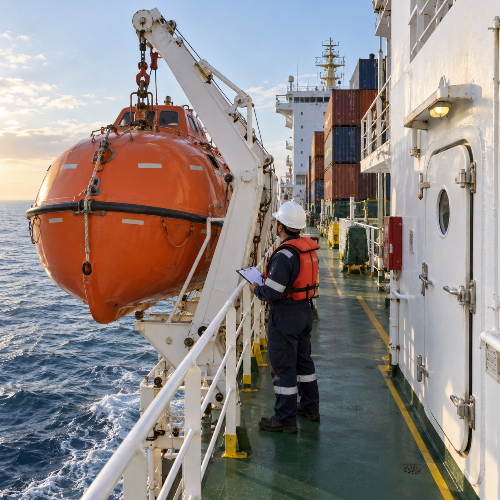
Explain how SOLAS requirements shape ship subdivision, fire protection, and life-saving arrangements.
Differentiate the main pollution-prevention and collision-avoidance rules in MARPOL, COLREG, and related conventions.
Compare the design features and operational constraints of container ships, bulk carriers, RoRo ships, and tankers.
Interpret how major maritime casualties influenced later design rules and safety requirements.
Apply core hull-form and bulbous-bow concepts to evaluate design trade-offs in merchant ships.
Skills and knowledge
SOLAS
MARPOL
COLREG
Ship design
Bulk carriers
Tankers
Hull forms
Maritime safety
Course curriculum
Introduction
1.1 Welcome
SOLAS Safety Requirements
2.1 Subdivision and Stability
2.2 Probabilistic Damage Stability
2.3 Fire Protection Systems
2.4 Life-Saving Arrangements
2.5 Damage Stability Worked Example
2.6 Quiz 1 (quiz)
Pollution and Navigation Rules
3.1 MARPOL Annexes
3.2 Ballast Water and Related Rules
3.3 COLREG Equipment Requirements
3.4 Other Design Conventions
3.5 Quiz 2 (quiz)
Container and Bulk Carriers
4.1 Container Ship Development
4.2 Container Equipment and Security
4.3 Bulk Carrier Design Basis
4.4 Casualty and Loading Implications
4.5 Ship-Type Comparison Task
4.6 Cargo Capacity Worked Example
4.7 Quiz 3 (quiz)
RoRo Ships and Tankers
5.1 RoRo Ship Types
5.2 RoRo Casualties and Stability
5.3 Securing and Tanker Systems
5.4 Quiz 4 (quiz)
Hull Form and Bulbous Bow
6.1 Hull Form Classification
6.2 Series and Benchmark Hulls
6.3 Bulbous Bow Principles
6.4 Bulb Design Coefficients
6.5 Hull Form and Bulb Worked Example
6.6 Quiz 5 (quiz)
Summary
7.1 Key Takeaways
Ready to enrol?
£299.00