
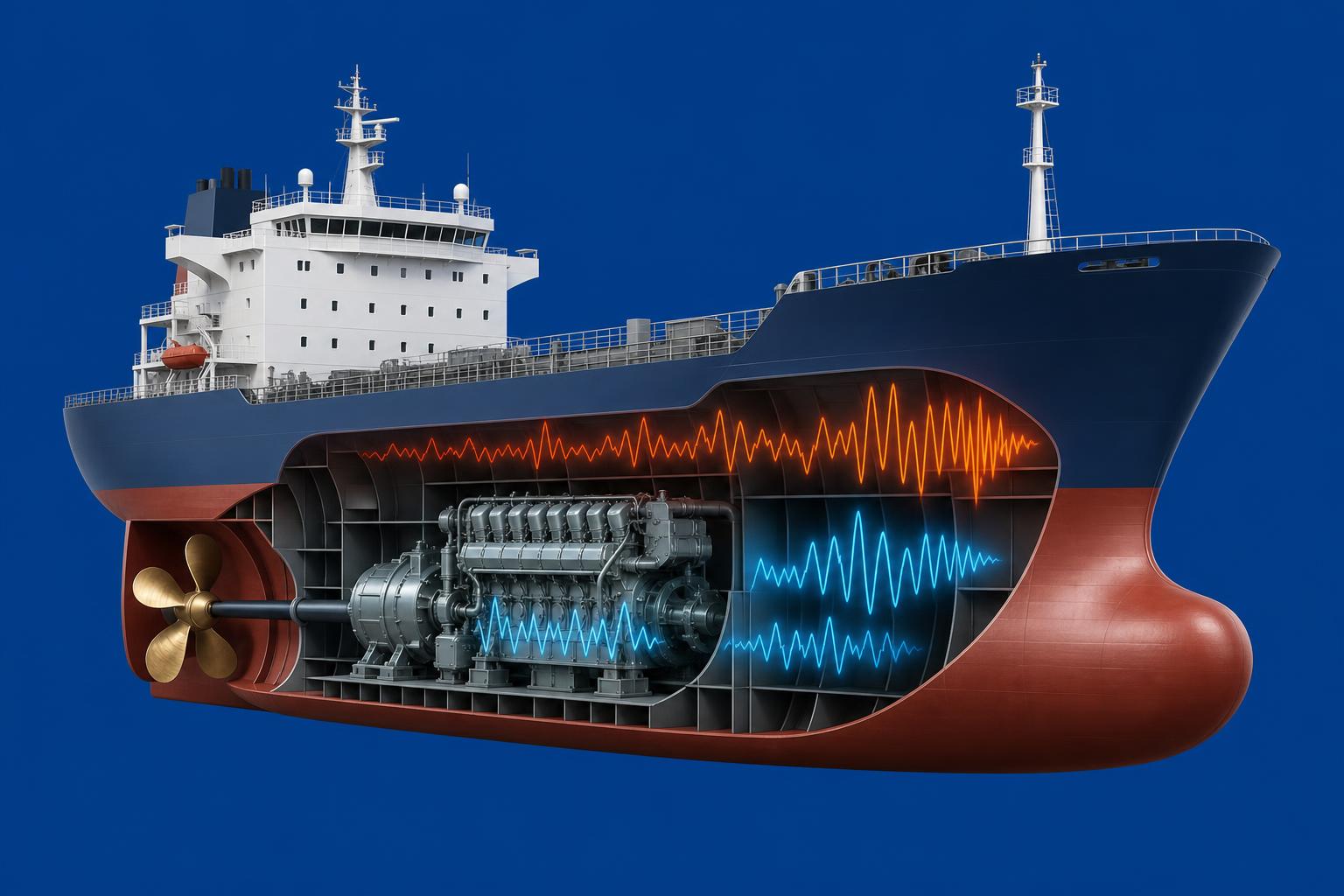
A06 – Ship Vibration and Noise
An undergraduate course on ship vibration and shipboard noise, based on translated source materials from a third-year Bachelor Maritime Technology module. It develops core vibration theory, hydrodynamic effects, shaft dynamics, sound assessment, and shipboard noise prediction through worked maritime examples and practicum-linked concepts.
£299.00
1 hour 19 minutes
Focused, self-paced learning designed to fit around professional schedules.
Online, self-paced
Study online at a pace that fits your schedule.
10 sections
Structured curriculum sections.
English
Language of instruction for this course.
35 lessons
Focused lessons organised into a clear learning path.
Course overview
An undergraduate course on ship vibration and shipboard noise, based on translated source materials from a third-year Bachelor Maritime Technology module. It develops core vibration theory, hydrodynamic effects, shaft dynamics, sound assessment, and shipboard noise prediction through worked maritime examples and practicum-linked concepts.
What you will learn
Set up and solve single-degree-of-freedom vibration models for ship-related mass-spring-damper systems.
Estimate the lowest natural frequency of beams and deck panels using Rayleigh’s method.
Analyze how added mass and damping from surrounding water change the vibration behavior of wetted structures.
Evaluate whirl and torsional-vibration risks in propeller-shaft systems against operating-speed excitation.
Apply decibel, frequency-band, NR-curve, and dB(A) methods to interpret shipboard noise data.
Predict shipboard noise at a receiver location using source, path, and transmission-loss reasoning.
Skills and knowledge
Ship vibration
Rayleigh method
Added mass
Shaft dynamics
Modal analysis
Shipboard noise
Vibration isolation
Noise prediction
Course curriculum
Introduction
1.1 Welcome
SDOF Vibration Models
2.1 Equation of Motion
2.2 Resonance and Frequency Limits
2.3 Real Structures and Damping
2.4 Quiz 1
Beam Vibration and Rayleigh
3.1 Uniform Beam Equation
3.2 Using Rayleigh’s Method
3.3 Practicum Beam Estimate
3.4 Deck Panels and Model Limits
3.5 Quiz 2
Added Mass in Water
4.1 What Added Mass Means
4.2 Ship Structures in Water
4.3 Wet-Beam Frequency Shift
4.4 Pontoon Hydrodynamics
4.5 Quiz 3
Shaft Whirl and Torsion
5.1 Whirl in Rotating Shafts
5.2 Reading the Whirl Diagram
5.3 Torsional Reduced Models
5.4 Drivetrain Design Cases
5.5 Mitigation Strategies
5.6 Quiz 4
Superstructure and Modal Behavior
6.1 Local and Deckhouse Modes
6.2 Modal Analysis Tools
6.3 Quiz 5
Propeller Excitation and Cavitation
7.1 Propeller-Hull Excitation
7.2 Cavitation Noise Control
7.3 Quiz 6
Sound Fundamentals and Rating
8.1 Decibels and Frequency Bands
8.2 NR Curves and A-Weighting
8.3 Quiz 7
Transmission and Noise Prediction
9.1 Transmission Paths
9.2 Resilient Mount Isolation
9.3 Noise Prediction Workflow
9.4 Quiz 8
Summary
10.1 Key Takeaways
Ready to enrol?
£299.00